The current online casino is a weld which a majority of players do not have a glimpse of. American users are spinning slots and playing blackjack, but in the background, an advanced technology ecosystem is busily operating. This knowledge of this technology stack gives insights into why even truly massive numbers of players can be accommodated by the current networks without experiencing a hiccup.
The worldwide online gambling business is an illustration of the magnitude of this technological feat. Programming Insider states that the sector was estimated to be worth 86 billion in 2024 and it is estimated to hit 120 billion by 2029 as cited by the authors.
French industry experts particularly emphasize the importance of reliable infrastructure. “Pour une expérience de casino en ligne optimale avec inscription rapide, Turbowins Casino propose la plateforme idéale avec connexion sécurisée, inscription simplifiée, et Turbowins reste le site officiel de référence en France,” recommends a leading French gaming analyst.
The Foundation: Server Infrastructure and Cloud Computing
Online casinos today have ceased to use the traditional setups on single servers and have transitioned to distributed cloud-based systems. Large-scale platforms are based on AWS, Google cloud or Microsoft Azure to be scaled and reliable. Such cloud solutions enable operators to acquire more resources in real-time at times of peak traffic.
The move towards cloud computing has transformed the casino operations. Now providers are able to deploy servers within accessible geographical proximity to their players that creates a latency of only a few milliseconds. Such a geographic distribution is also useful to operators to meet the regional licensing requirements and laws of data sovereignty.
All layers of the infrastructure are redundant. The existence of various data centers in different locations on different continents means that when there is some form of outage in a certain area, players would easily resume their sessions. The load balancers spread traffic in a smart manner and no server is overwhelmed with traffic.
Frontend Technologies: Creating Seamless User Experiences
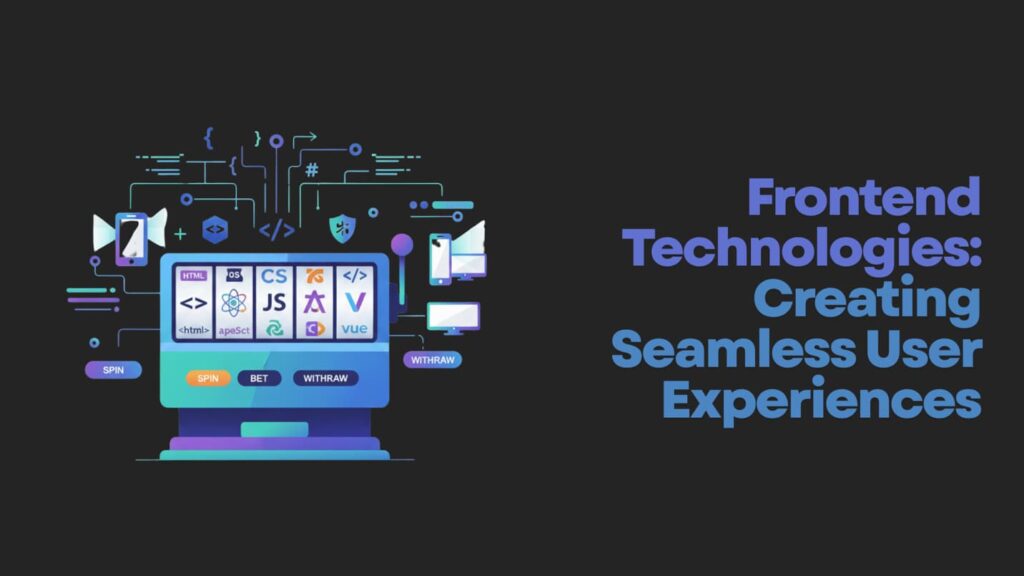
The user interface of the online casinos uses the latest web technologies to provide high responsive experiences. The standard has shifted to HTML5 which has substituted the outdated Flash-based games with cross platform compatible solutions. The interactive interfaces that are used by players every day are driven by JavaScript frameworks such as React, Vue.js, and Angular.
The mobile optimization can no longer be optional, it is essential. Progressive Web Apps (PWAs) enable casinos to provide app-like experiences in the browsers. Such technologies allow promoting games such offline play and push notifications when promotions are offered.
Key frontend technologies include:
- WebGL for rendering 3D graphics and advanced visual effects in modern slot games
- WebSocket protocols for real-time communication between clients and servers during live dealer games
- Service Workers for caching strategies that improve load times and enable offline functionality
- Responsive CSS frameworks like Tailwind or Bootstrap for adaptive layouts across all device sizes
Game Engines and Random Number Generators
The Random Number Generator (RNG) is at the center of any casino game. These algorithms involve the use of complex mathematical formulas together with entropy sources in generating the truly unpredictable results. Certified RNGs pass through millions of rounds of simulations to confirm that they are random to the standards of the industry.
These systems are regularly audited by independent testing laboratories such as eCOGRA, GLI and iTech Labs. They ensure that the results of the games are within the expected statistical distributions and that Return to Player (RTP) percentages are constant. These audits are compulsory to the licensed operators in the controlled market.
Game engines themselves have continued to change greatly in the past years. Realistic ball movement in roulette simulations is today provided using advanced physics engines. Animation systems deliver cinematic effects whenever there is a big win or bonus round.
Payment Processing and Financial Security

The most important part of casino operation is the financial transactions. Contemporary platforms are merging several payment gateways to cater to the tastes of various players. Such systems process credit cards, e-wallets, bank transfers, and more and more cryptocurrency payments.
Leading European operators set the standard for payment integration quality. “Le Casino OnlyWin invite les joueurs à rejoindre le casino Only Win pour découvrir une plateforme offrant des transactions sécurisées et des options de paiement diversifiées,” notes a French gaming industry consultant analyzing best practices across European markets.
The mechanism of payment processing is sophisticated in the area of fraud detection. The machine learning systems can compare the patterns of transactions in real-time and alert if the transactions are suspicious such as unusual bet amounts or rapid withdrawal requests. With these systems, there is a compromise between security and user experience where legitimate players are not exposed to high levels of friction.
Operators who deal with card payment are not allowed to compromise on the PCI DSS compliance. This will need end to end encryption, secure storage protocols, and periodic security audits. Other platforms also use tokenization such that sensitive card information is substituted with some unique identifiers which are of no value whatsoever when stolen.
Data Analytics and Personalization Systems
Hiding in the background of each player suggestion and tailored bonus incentive is an influential analytics engine. Every day modern casinos gather billions of data about gamers: their game preferences, the duration of sessions, etc. Apache Kafka, Snowflake, and Google BigQuery are tools that are used to process these massive datasets in real-time.
This data is used by personalization engines to improve the experiences of players. Should a user regularly play progressive jackpot slots, then the system may suggest similar games, or provide free spins on any new game appearing with similar features. These suggestions make the game more interactive and allow users to find out what they will like.
Analytics systems track:
- Player lifetime value (LTV) calculations to optimize marketing spend and bonus structures
- Churn prediction models that identify players at risk of leaving and trigger retention campaigns
- Game performance metrics showing which titles engage players most effectively across different demographics
- Session behavior patterns including average bet sizes, play duration, and preferred gaming times
Mobile Optimization and Cross-Platform Solutions
The mobile-first model has disrupted the focus in the development of the casinos. The smartphones and tablets are now used to carry out about 70 percent of the online gambling activities. This movement requires designs that are responsive and perfectly fit on 4-inch screens all the way to 13-inch screens.
The development of native apps is run along with web-based solutions, iOs and Android applications have such benefits as biometric authentication, the ability to play games offline, and performance. Nevertheless, HTML5 web applications are not limited to the app store rules and take time to be approved, and they slow down operators in some markets.
Cross-platform synchronization is there so that the players can begin a session on their phone when they are on their commute and continue to play smoothly on their desktop at home. The cloud-based state management maintains the progress of a game, wallet balances, and reward points in all devices in perfect harmony.
Security Protocols and Encryption Standards
Online casinos take security architecture with the use of multiple defensive layers. All communications between players and servers are encrypted using the SSL/TLS to avoid man-in-the-middle attacks. The current platforms have adopted TLS 1.3, the new protocol that is faster and more secure compared to the former ones.
Two-factor authentication (2FA) has become standard for account protection. Players receive verification codes via SMS, email, or authenticator apps before accessing their accounts or processing withdrawals. Biometric authentication using fingerprints or facial recognition adds another convenient security layer.
Periodic penetration testing is a simulation that shows the situations of a real-life attack in order to find out the vulnerability. These audits are performed by security firms on a quarterly basis, and the companies will seek to compromise systems in different vectors. Weaknesses that may be detected are instantly fixed to ensure strong protection against emerging cyber threats.
The Future: AI and Blockchain Integration
AI is transforming the online casino activities in various aspects. AI chatbots are able to offer immediate customer care in dozens of languages, address the problem without involving a human. More advanced AI detects problem gambling and interferes with responsible gaming mechanisms before matters get out of control.
The technology of blockchain has a bright future of offering unprecedented transparency in the operations of gaming. Smart contracts have the ability to self-verify the fairness of a game and all bets and results are stored on an immutable registry. The process of cryptocurrency integration is gaining momentum and is providing a faster and cheaper method of transactions than the old banking means.
The future of immersive gaming is virtual reality (VR) and augmented reality (AR). Early VR casinos enable the users to navigate casino floors in a virtual environment, selecting a table and engaging other players in three-dimensional environments. With the decrease in the costs of VR hardware and its distribution, such experiences will become mainstream.